by Raffaella Milandri©
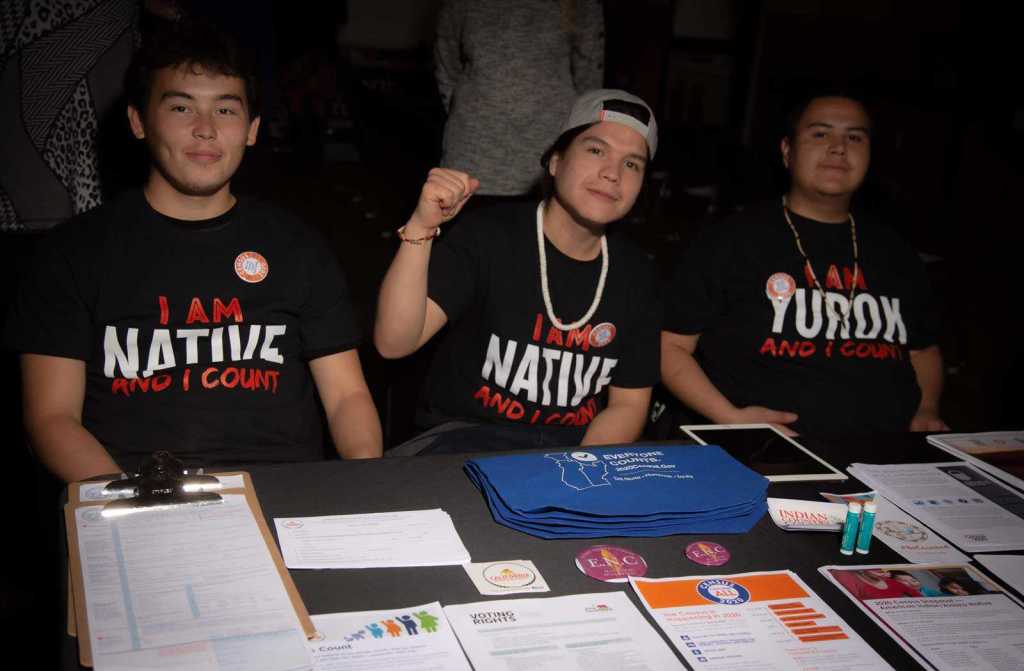
It is since 1965, with the Voting Rights Act signed by US President Lyndon Johnson, that Native Americans have been granted the full right to vote. But it has never been easy for them to vote. Today, Native people say they still face barriers to casting their vote. Let us see why.
Problems of accessibility to vote
According to NCLS data, over 4.7 million Native Americans are eligible to vote, but only 66% of them are registered to vote, according to the Native American Rights Fund’s (NARF) report Obstacles at Every Turn: Barriers to Political Participation Faced by Native American Voters. First of all, their electoral participation is difficult to identify. Unlike for other population groups, the US Census Bureau does not report voter registration and turnout specifically for Native Americans, as we see in the exit poll example here. In addition to this ‘different’ consideration, there is also the issue, highlighted loudly in the Native media in the 2020 election, of accessibility to voting. Many Natives live miles away from voter registration sites and polling stations and do not have access to reliable transportation, especially in remote areas and on reservations. Others do not have access to the internet for online registration. Many do not have a traditional postal address and cannot meet voter registration requirements, which require proof of residency. For example, in Chilchinbeto, Arizona, on the Navajo reservation, some 40,000 homes do not have a traditional address. Voting by mail can be ‘problematic’, according to O.J. Semans, a Sicangu Lakota citizen living on the Rosebud Reservation in South Dakota, and co-executive director of Four Directions, a voting rights advocacy group that has worked on behalf of tribes in several states. ‘It must be remembered that since the days of the old Pony Express (mail delivery by horseback) the service was not for the reservations. It was for outposts and settler towns,’ Semans said. ‘The United States Postal Service has always neglected Indian reservations when it comes to ensuring equality.’ The Voting Rights Act of 1965 had banned traditional forms of voter discrimination, such as literacy tests, character assessments and other practices widely used to exclude minority voters. It thus authorised the federal government to oversee voter registration and election procedures in some states and localities with a history of discriminatory practices, while also requiring these jurisdictions to obtain ‘pre-clearance’ from the Department of Justice or a federal court before changing voting laws or procedures. In 2013, the US Supreme Court struck down the formula for deciding which localities required preclearance as unconstitutional, paving the way for states to pass new voting laws, reopening possible difficulties for native voters. During a Senate Indian Affairs Committee hearing in 2021, Jacqueline De Leon, an enrolled member of Isleta Pueblo and staff attorney for the Native American Rights Fund, NARF, described some of the conditions for indigenous voters. ‘In South Dakota, Native American voters were forced to vote in a repurposed chicken coop, with no toilet facilities and feathers on the floor,’ she testified. In Wisconsin, Native Americans had to vote inside a sheriff’s office.
Republicans and Democrats
In 2021, President Biden created the Interagency Steering Group on Native American Voting Rights to report on barriers faced by Native voters. The group reported that Native American communities have not been safeguarded, rather they have been confined or divided by district lines that dilute their vote or are otherwise discriminatory. In November 2021, the Republican-led North Dakota legislature passed a new legislative map that separated state House districts into the Turtle Mountain Indian Reservation and the Fort Berthold Reservation, home to the Three Affiliated Tribes. The Turtle Mountain Band of Chippewa and Spirit Lake tribes filed a federal lawsuit claiming that the new map violated the Voting Rights Act by confining the Turtle Mountain band – that is, concentrating it in a single election district to reduce its influence in other districts – and splitting and dividing the Spirit Lake tribe between districts to dilute its voting power. ‘A conservative judge found this to be a clear violation of the Voting Rights Act,’ De Leon said. ‘And rather than protect native voters in the event of a violation, the state appealed, seeking to block the course of action instead of remedying the discrimination.’
Returning to the issue of voting by mail, under Republican Governor Doug Ducey Arizona passed a law in 2022 requiring voters to provide proof of their physical address. As we saw earlier when discussing the example of Chilchinbeto on the Navajo reservation, some 40,000 homes have no traditional address or way to prove the location of residence. With the support of NARF, the Tohono O’odham Nation and the Gila River Indian Community filed a lawsuit in the US District Court for Arizona in 2022. In 2023, the court ruled in their favour, finding that the address requirements violated the tribe members’ constitutional right to vote. Ahead of the November 2024 general election, Semans said indigenous voting rights activists must remain vigilant. ‘With this new Supreme Court, even the rulings we got years ago that were good for us could change before then. Things can change in an instant.’
To whom Native American votes will go
The Native vote preferences are certainly not a foregone conclusion, even though today they show a majority in favour of the Democrats. I appeal, as always, to data and statistics. At first glance, Trump would certainly not be considered a ‘friend’ of Native Americans, even though he did some positive things for them at the end of his previous term, such as promoting a task force for the serious problem of ‘missing and murdered indigenous women’. But if we read a press release from the Commission on Indian Affairs, he was accused of attacking tribal sovereignty, in addition to various issues on pipelines that violated Native lands. So, in general, the Democrats have given the Natives a better political reception, for example by electing a Native woman, Deb Haaland – who was much overshadowed during her tenure – as Secretary of the Interior. Records of the first elections in which Native Americans could vote are scarce. Often, even today, the Native vote is grouped in demographic studies under the category ‘other’, other (see photo exit polls 2016 and 2020). What is known is that Native people have developed great support for the Democratic Party, like African-Americans, since their inclusion and participation in New Deal programmes. Some specific tribes, such as the Navajo, have historically preferred the Republican Party, although this too has changed. Between 1984 and 1996, support for the Democratic Party never fell below 75%. In general, Native Americans are more likely to vote Democratic. Exit polls show that Natives were initially more willing to vote for Donald Trump in the 2016 election. However, while the Native vote tilted towards Joe Biden in the subsequent election, securing Arizona for the Democrats, the NPR news outlet reported that Natives voted for Trump over Biden nationally (albeit narrowly) at 52% to 45% ( under ‘Other’). Republican and conservative politics tend to do better with Natives in mixed contexts, i.e. in more rural constituencies, as seen in the recent 2020 election (see Biden/Trump 2020 exit poll, again under ‘other’). Political researchers have seen great potential in the native vote for many years. Research dating back to 1997 suggests that Native people had potential as swing voters in what at the time were considered fairly equal Democratic and Republican registrations, such as Montana. Although today’s trends make these states seem much more solidly Republican, the case of Arizona (a state once considered ‘solidly red’) in 2020 has led political research to refocus on this phenomenon of their ‘swing power’. For this article, I spent about two hours searching through the 2024 voting predictions of ‘white’, ‘black’, ‘asian’ and ‘hispanic’ Native Americans, but to no avail. Nothing, they are not considered in the current exit polls. Yet, Kamala Harris has already told the Native newspaper Native News Online: ‘I will always honour tribal sovereignty and respect tribal self-determination’. We will see if, should she be elected, she will keep her promises. Recall that Obama has been strongly supportive of the Native American community: in 2008, during his election campaign, he visited the Crow Nation in Montana, where he was adopted into the Black Eagle family, and then visited a number of reservations, as well as enacting the Tribal Law and Order Act of 2010 and the Indian Health Care Improvement Act in the same year.
Published originally in Italian in The AntiDiplomatico, 13 August 2024
“Nativi” column by Raffaella Milandri
https://www.lantidiplomatico.it/news-nativi/53237/
Articles by Raffaella Milandri
- Revenge of the Native Americans? Killers of the Flower Moon and Lily Gladstone
- What lies behind Pope Francis’ apology to Native Americans, exploring the historical context and significance of his statement in relation to Indigenous rights and healing
- The truth about Indian reservations. The lands do not belong to the Native Americans
- Forgetting the Native American Genocide: over 55 million dead
- Forced sterilisation: the latest weapon against Native Americans
- Leonard Peltier: the appeal for the Native American activist after 47 years of maximum security imprisonment
- Sioux-Lakota ban Governor Kristi Noem from entering Indian reservations
- Indian reservations inspired Nazi concentration camps
- Nuclear tests and toxic waste on Indian reservations. The film ‘Oppenheimer’ doesn’t tell it right
- Secret medical experiments on Native people in Canada: a lawsuit to prove it still happens today
- The ‘Manifest Destiny’ of the United States, Native Americans and the Rest of the World
- How do Native Americans see the situation in Gaza: a parallel path?
- Native American voting discrimination in US elections
- The paradox of Puerto Rico: American citizens but without the right to vote
- Native Americans and firewater (and Tim Sheehy’s statements)
- Alarm over Canadian police violence towards Native people: nine dead in the last month alone
- Canada tried – and still insists – on erasing Native rights
- Biden apologises to Native Americans: the (negative) comments and the background
 Nativi Americani ieri e oggi
Lascia un commento