by Raffaella Milandri©
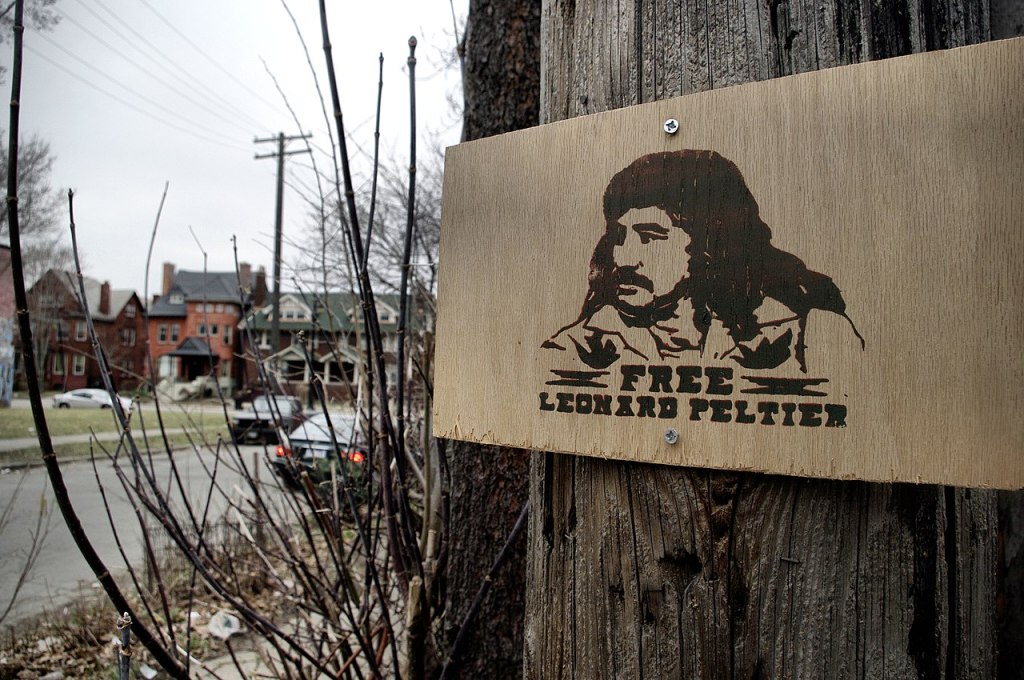
A case that has America debating. Incarcerated since 1977 on the dubious charge of killing two FBI agents, Peltier’s new parole hearing will be held on 10 June after 15 years. Over the years, the case for his freedom has been supported by great human rights symbols, such as Nelson Mandela, John Lennon, the Dalai Lama and Mother Teresa of Calcutta. His case has always been deemed unjust, except by the US government justice system. In 2017, Obama denied him clemency.
The 1970s
It is necessary to put the historical context of the years leading up to the events of Leonard Peltier into context. It was a period fraught with tensions. It was the early 1970s, and the United States was a powder keg: on the one hand, the Nixon administration was promoting ‘Law and Order’ as its watchword; on the other, protests against the war in Vietnam were raging, the first protests against nuclear power were rising, and struggles for human rights and equality were spreading. J. Edgar Hoover had been in office since 1924 (he remained there until his death in 1972) as director of the FBI: he had gained unprecedented power, which allowed him to personally influence presidents and politics and secured his position for 48 years.
In racist and puritanical America, the actions and protests of two movements such as the Black Panther Party for the rights of African Americans and the American Indian Movement (AIM, part of the Red Power Movement) for the rights of Native Americans shook the foundations of the government system and the consciences of the American middle classes. Events carried out in those years by the American Indian Movement include the Alcatraz Occupation, the Broken Treaty Trail, the Wounded Knee Occupation, as well as intermittent protests and occupations over the years. The Red Power movement led to the resurrection of American Indian pride, action and awareness.
The Occupation of Alcatraz
The Occupation of Alcatraz (20 November 1969 – 11 June 1971) was a 19-month protest in which 89 Native Americans and their supporters occupied Alcatraz Island. The protest was led by Richard Oakes, LaNada Means and others, with John Trudell acting as spokesman. The group lived together on the island until the protest was forcibly interrupted by the US government. The protest group chose the name Indians of All Tribes (IAT). The IAT argued that, according to the Treaty of Fort Laramie between the United States and the Lakota tribe, all federal land that had been disposed of or abandoned had to be returned to the indigenous peoples who occupied it. Since the Alcatraz Penitentiary had been closed on 21 March 1963 and the island had been declared disused federal property in 1964, Red Power activists believed the island qualified for an Indian claim. The occupation of Alcatraz had a brief effect on federal policies but set a precedent for Indian activism. Oakes was killed in 1972 and the American Indian Movement was later targeted by the federal government and the FBI in the COINTELPRO operations (which I will not go into in this article).
The Trail of Broken Treaties
The Trail of Broken Treaties was a caravan of American Indian and First Nations associations that started on the west coast of the United States in 1972 and ended at the headquarters of the Department of the Interior in the United States capital, Washington D.C. Participants demanded the restoration of the authority of the tribes in the making of treaties, the abolition of the Bureau of Indian Affairs (BIA), and federal investment in jobs, housing, and education. The eight organisations in the caravan included the American Indian Movement (AIM), the Canadian National Indian Brotherhood (later renamed the Assembly of First Nations), the Native American Rights Fund, the National Indian Youth Council, the National American Indian Council, the National Council on Indian Work, the National Indian Leadership Training and the American Indian Committee on Alcohol and Drug Abuse. In Minneapolis, AIM headquarters, the activists developed a twenty-point position paper to define their demands.
The Occupation of Wounded Knee
Also known as the Second Wounded Knee, it began on 27 February 1973, when some 200 Oglala Lakota and American Indian Movement (AIM) followers seized and occupied the town of Wounded Knee, South Dakota, United States, on the Pine Ridge Indian Reservation. The protest followed the failure of an attempt by the Oglala Sioux Civil Rights Organisation (OSCRO) to use impeachment to remove tribal President Richard Wilson, who was accused of corruption and abuse. In addition, the protesters protested the US government’s non-compliance with treaties by demanding the reopening of negotiations to achieve fair and equitable treatment of Native Americans. The Oglala and AIM activists occupied the township for 71 days while the United States Marshals Service, FBI agents and other law enforcement agencies cordoned off the area. The activists chose the site of the 1890 Wounded Knee Massacre for its symbolic value. The occupation attracted widespread media coverage and many Native supporters travelled to Wounded Knee to join the protest. Later, AIM leaders Dennis Banks and Russell Means were indicted on charges related to the events, but their 1974 case was dismissed in federal court for prosecutorial misconduct.
Leonard Peltier
Leonard Peltier (born 12 September 1944) has Lakota, Dakota and Anishinaabe ancestry and grew up between the Turtle Mountain Chippewa and Fort Totten Sioux Nations reservations in North Dakota. He attended one of the infamous Indian residential schools, the Wahpeton Indian School in Wahpeton, North Dakota, run by the Bureau of Indian Affairs (BIA). A Native American activist and member of the American Indian Movement since 1972, following a controversial trial, he was convicted of two counts of conspiracy to commit murder in the deaths of two Federal Bureau of Investigation (FBI) agents in a shooting on 26 June 1975 on the Pine Ridge Indian Reservation, South Dakota. He was sentenced to two consecutive life sentences and has been in prison since 1977 (currently 47 years). Peltier was granted the possibility of parole in 1993. As of 2022, Peltier is incarcerated at the United States Penitentiary, Coleman, Florida. In his memoir ‘My Life is My Sun Dance’, Peltier admitted that he participated in the shooting, but did not kill the FBI agents. Human rights watchdogs, such as Amnesty International, and political figures, including Nelson Mandela, Mother Teresa and the 14th Dalai Lama, campaigned for Peltier’s clemency. On 18 January 2017, then-President Barack Obama denied Peltier’s clemency request.
The shooting
On 26 June 1975, Special Agents Ronald Arthur Williams and Jack Ross Coler of the Federal Bureau of Investigation (FBI) went to the Pine Ridge Indian Reservation to find a young man named Jimmy Eagle, wanted for questioning for assault and theft of a pair of cowboy boots. Shortly after 11 a.m., Williams and Coler spotted and followed an orange and white Chevy Suburban Carryall carrying Leonard Peltier, Norman Charles and Joe Stuntz. Peltier had an outstanding federal warrant for attempted murder of a Milwaukee police officer – although Williams and Coler were unaware of this. It appears that the occupants of the Suburban stopped, exited the vehicle, and shot Williams and Coler. But it is unclear whether the occupants of the vehicle started shooting first or whether it was Williams or Coler. Between 11:45 a.m. and 11:50 a.m. Williams radioed that they were shot by the occupants of the vehicle and would be killed if backup did not arrive. FBI Special Agent Gary Adams was the first to respond to Williams’ request for assistance from twelve miles away. But he and the other BIA agents who responded were also shot at. They could not reach Coler and Williams in time: both agents died in the first ten minutes of gunfire. It was not until around 16:25 that the authorities were able to recover the bodies of Williams and Coler from Coler’s vehicle. The two officers had fired a total of five shots. In total, 125 bullet holes were found in the officers’ vehicles.
Trial
On 22 December 1975, Peltier was placed on the FBI’s Ten Most Wanted Fugitives list. On 6 February 1976, Peltier was arrested by the Royal Canadian Mounted Police in Hinton, Alberta, Canada. In December 1976, Peltier was extradited from Canada. Peltier’s trial was held in Fargo, North Dakota, where a jury convicted him of the murders of Coler and Williams. In April 1977, Peltier was sentenced to two consecutive life sentences.
Inconsistencies in the prosecution’s case
Numerous doubts were raised about Peltier’s guilt and the fairness of his trial, based on allegations and inconsistencies in the handling of the case by the FBI and the prosecution. Several key witnesses in the original trial recanted their statements and claimed they were coerced by the FBI. At least one witness was granted immunity from prosecution in exchange for testifying against Peltier.
Retracted witness statements
Peltier was convicted in 1977 largely on the basis of evidence presented by a single witness, known to be mentally unstable, who placed him at the scene of the shooting and claimed that Peltier had planned his crimes. This was confirmed when the FBI deemed the witness unfit to testify in court. But her testimony remained a key part of the prosecution’s case against Peltier. Two other witnesses, whose testimony was used to place Peltier at the crime scene, also later recanted. They claimed that the FBI had coerced and threatened them, tied them to chairs, denied them the right to speak to their lawyer and otherwise intimidated them.
Discrepancies in physical evidence
FBI radio intercepts indicated that the two FBI agents Williams and Coler had entered the Pine Ridge Reservation in pursuit of a suspected thief in a red pick-up truck. But it was proved that Peltier was driving a Chevrolet Suburban, orange with a white roof. At Peltier’s trial, the FBI changed its earlier statements that it was looking for a red pick-up truck and instead stated that it was looking for an orange and white van, similar to the one Peltier was driving. This contradictory statement by the FBI was a highly controversial issue of evidence in the trials. The court did not allow the defence to present information to the jury in Fargo about other cases in which the FBI had been reprimanded for tampering with evidence and witnesses.
Escape from prison in 1979
Peltier began serving his sentence in 1977. On 20 July 1979, he and two other inmates escaped from the Federal Correctional Institution in Lompoc. One inmate was shot by a guard outside the prison and the other was captured 90 minutes later, about 2 km away. Peltier was captured by a search team three days later near Santa Maria, California. After a six-week trial held in Los Angeles, Peltier was sentenced to serve an additional five years for escape and a two-year sentence for possession of a stolen firearm while on the run, in addition to his two previous life sentences.
Probation hearing on 10 June 2024 and predictions
Leonard Peltier, almost 50 years after his conviction, remains the most controversial and powerful symbol of the violent civil rights struggle in the United States. In recent months his health – already difficult for several years – has deteriorated, so much so that his lawyers say they fear he will not make it to his June parole hearing. ‘At a time when democratic values are being challenged, the Justice Department should act near the end of his life and allow him to return to his family in his ancestral homeland,’ Judith LeBlanc, director of the Native Organisers Alliance, said in a statement. ‘We implore the Department of Justice to grant Peltier’s compassionate release.’
The demands for Peltier’s release are very pressing on the Biden administration, particularly since it has always said that Native American rights are a priority. Amnesty International is campaigning hard. Many associations around the world, including in Italy, are promoting his freedom. And I urge everyone to promote it. His conviction with many judicial shadows, after 47 years, can be taken for granted. What will happen?
The Law and Order issue is always at the forefront in the United States, we see this with the repression of pro-Palestinian demonstrations these days. After a brief recap of the background, I look at the day-to-day and unfortunately hold out little hope. Leonard Peltier’s problem – like Assange’s – is that he is a symbol that the strong powers are afraid of. Too afraid to let him go. But I sincerely hope I am wrong. May Leonard Peltier celebrate his 80th birthday with his family, his people and his traditions.
Published originally in Italian in The AntiDiplomatico, 8 May 2024
“Nativi” column by Raffaella Milandri
https://www.lantidiplomatico.it/news-nativi/53237/
Articles by Raffaella Milandri
- Revenge of the Native Americans? Killers of the Flower Moon and Lily Gladstone
- What lies behind Pope Francis’ apology to Native Americans, exploring the historical context and significance of his statement in relation to Indigenous rights and healing
- The truth about Indian reservations. The lands do not belong to the Native Americans
- Forgetting the Native American Genocide: over 55 million dead
- Forced sterilisation: the latest weapon against Native Americans
- Leonard Peltier: the appeal for the Native American activist after 47 years of maximum security imprisonment
- Sioux-Lakota ban Governor Kristi Noem from entering Indian reservations
- Indian reservations inspired Nazi concentration camps
- Nuclear tests and toxic waste on Indian reservations. The film ‘Oppenheimer’ doesn’t tell it right
- Secret medical experiments on Native people in Canada: a lawsuit to prove it still happens today
- The ‘Manifest Destiny’ of the United States, Native Americans and the Rest of the World
- How do Native Americans see the situation in Gaza: a parallel path?
- Native American voting discrimination in US elections
- The paradox of Puerto Rico: American citizens but without the right to vote
- Native Americans and firewater (and Tim Sheehy’s statements)
- Alarm over Canadian police violence towards Native people: nine dead in the last month alone
- Canada tried – and still insists – on erasing Native rights
- Biden apologises to Native Americans: the (negative) comments and the background
 Nativi Americani ieri e oggi
Lascia un commento