by Raffaella Milandri©
At last, there is talk of Native Americans. From Scorsese’s latest film, however, more was expected. In the meantime, millions of Native Americans have been hoping to applaud Lily Gladstone, the first Native American ever nominated for an Oscar for Best Actress.
In Italy, there are many American Indian enthusiasts, linked both to national realities that have had a strong cultural impact, from the paper hero Tex Willer to the songs of Fabrizio De Andrè, and to great films – on the side of the ‘Indians’ – etched in memory: The Last of the Mohicans, Dances with Wolves, and the more recent The Secrets of Wind River and Hostiles. Yet it is a subject that is little known, both historically and in terms of current affairs.
Native Americans have undoubtedly emerged from the role of the ‘ugly and bad’ sung about in John Wayne’s films. We remember Wayne’s angry reaction during the famous episode at the 1973 Oscars, when Marlon Brando, an activist of the AIM, American Indian Movement, refused the prestigious statuette awarded to him for The Godfather. Sacheen Littlefeather, at Brando’s behest, took her place on stage to criticise the film and television industry’s portrayal of the native people, and was booed by the audience. But not only that: apparently John Wayne himself tried to remove her from the stage, and it took six security men to stop him. It is therefore also with the memory of that incident that we look forward to this year’s Oscar ceremony, wishing a ‘rematch’ through Lily Gladstone.
It must be said that there is still deep-rooted and persistent misinformation about Native Americans, from which we are not only immune in Italy, but also in the United States, their land. The reasons are to conceal the Western ‘original sin’. Native Americans are, in fact, the mirror of our world, symbols of the colonisation and conquest – at the harrowing – of non-European peoples and territories. To know their history means, in reality, to know ourselves and to plumb the dark meanders of the darkness of our ‘white’ world.
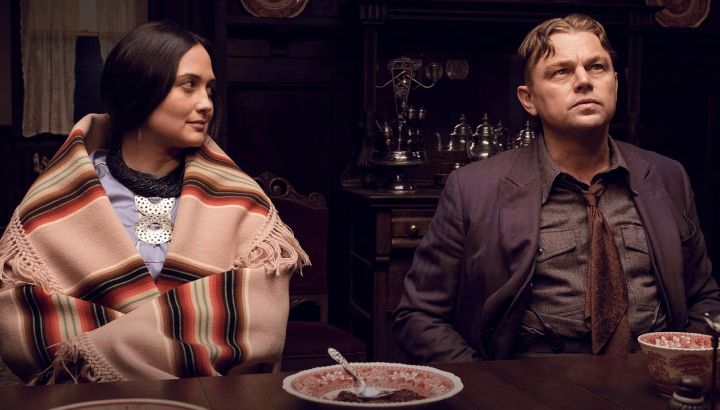
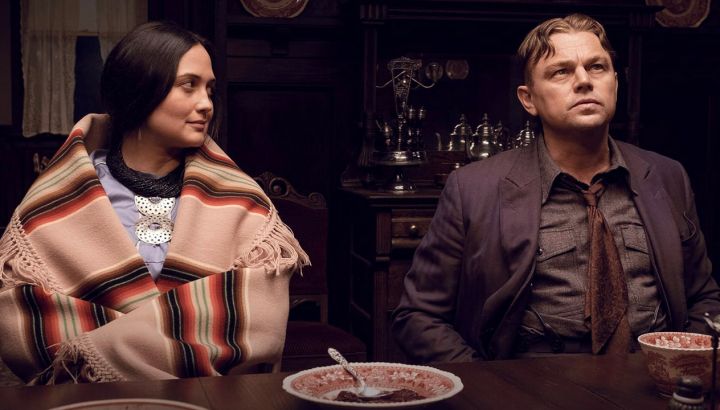
Therefore, much curiosity is aroused by Killers of the Flower Moon, in which the story of the Osage ‘Indians’ is told. A story in which ‘whites’ play the part of villains. In fact, very bad guys. The story that really happened is quickly told: on the Osage reservation, in the 1920s, an enormous oil deposit was discovered. In almost all Indian reservations, extreme poverty, forced assimilation, heavy discrimination, and a series of laws banning natives from the most basic rights (citizenship, voting rights, etc.) prevailed at the time. The tribes, from the beginning of the 19th century onwards, signed those famous treaties, often extorted by deception and force, that relegated them to patches of land in a North America that belonged to them in its entirety. For the most part, these lands are in designated and therefore resource-poor, arid and desert areas, where survival is difficult and where US government programmes decide the fate of the tribes.
In an atmosphere of profound racism, then, the unpredictable happens: right in the strip of land of the Osage suddenly oil literally gushes out of the ground. Various bureaucratic impediments prevent the Osage from directly enjoying the wealth of the black gold: for example, in the film, we see Mollie Burkhart, the protagonist played by Gladstone, entrusted to a white guardian who administers her property, as she is ‘incapacitated’. This alleged incapacity, which is not explained in the film, stems both from the offshoots of the Dawes Act, a law that had dismembered and administered the already gnawed property of the natives, and from the dismantling of the matriarchal society of the American Indian tradition. But it would be a long story to tell.
As a matter of fact, the Osage, although prevented from directly managing their wealth, began a new life at a very high level of prosperity. Much more affluent than the whites themselves, who in the film we even see playing the roles of labourers and waiters in their service. An unbearable and unbearable situation that leads to a series of murders against the Osage, where there is then a white person able to inherit or take over the benefits of oil.
We now come to the film and why we expected more from Scorsese. Basically, horrific serial crimes against the Natives are denounced; but the Natives themselves, apart from a few scenes related to ceremonies and traditions, are not given much space: to be clear, the general situation of the relationship between the tribes and the American government is not illustrated, nor are the myriad difficulties that afflicted – and to a large extent still afflict now – the life of the American Indians. Scorsese concentrates on the crime and detective track, to the detriment of the historical and political context. Of course, what happens is well understood, but he avoided going any further in explaining what it really meant to be a Native in the 1920s.
Doing justice, flanked by the sacred monsters De Niro and Di Caprio, is the often silent presence of Lily Gladstone: her gaze, her acting, restore all the drama of the Native world in America. Yesterday and today.
It only remains for us to wish her the best of luck for future victories, because the entire Native American community – over nine million according to the 2020 census – is unanimous and united, ready to celebrate, at last, a revenge.
Published originally in Italian in The AntiDiplomatico, 26 February 2024
“Nativi” column by Raffaella Milandri
https://www.lantidiplomatico.it/news-nativi/53237/
Articles by Raffaella Milandri
- Revenge of the Native Americans? Killers of the Flower Moon and Lily Gladstone
- What lies behind Pope Francis’ apology to Native Americans, exploring the historical context and significance of his statement in relation to Indigenous rights and healing
- The truth about Indian reservations. The lands do not belong to the Native Americans
- Forgetting the Native American Genocide: over 55 million dead
- Forced sterilisation: the latest weapon against Native Americans
- Leonard Peltier: the appeal for the Native American activist after 47 years of maximum security imprisonment
- Sioux-Lakota ban Governor Kristi Noem from entering Indian reservations
- Indian reservations inspired Nazi concentration camps
- Nuclear tests and toxic waste on Indian reservations. The film ‘Oppenheimer’ doesn’t tell it right
- Secret medical experiments on Native people in Canada: a lawsuit to prove it still happens today
- The ‘Manifest Destiny’ of the United States, Native Americans and the Rest of the World
- How do Native Americans see the situation in Gaza: a parallel path?
- Native American voting discrimination in US elections
- The paradox of Puerto Rico: American citizens but without the right to vote
- Native Americans and firewater (and Tim Sheehy’s statements)
- Alarm over Canadian police violence towards Native people: nine dead in the last month alone
- Canada tried – and still insists – on erasing Native rights
- Biden apologises to Native Americans: the (negative) comments and the background
 Nativi Americani ieri e oggi
Lascia un commento