
by Raffaella Milandri©
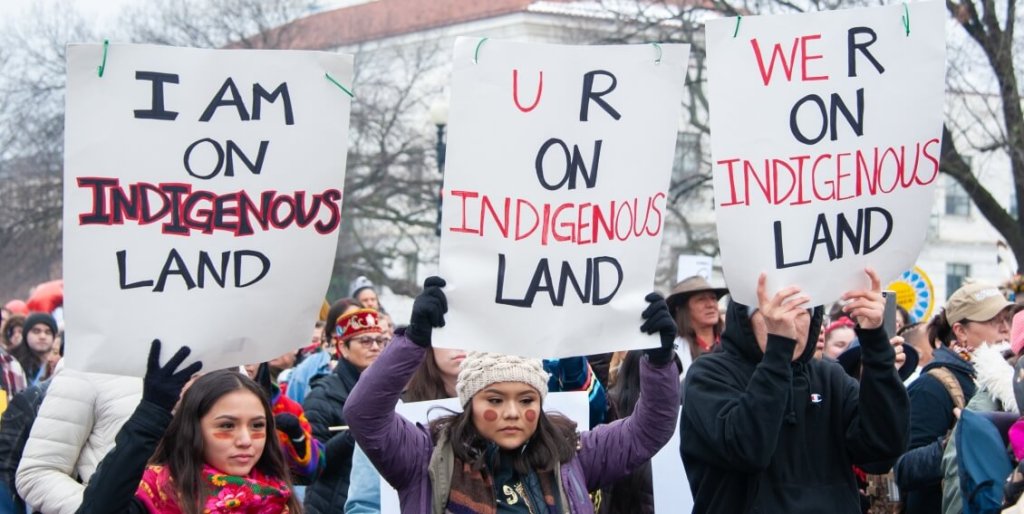
As on many topics related to Native Americans and Indigenous Peoples, there is much misinformation on Indian reservations, mainly caused by an attempt to conceal the injustices and abuses still suffered by American Indians and also by many Aboriginal peoples. After careful legislative study, we discover that Indian reservation territories are only given in ‘trust’ to American Indian tribes and that they cover between 1% and 2% of the United States.
The concept of a reservation
The term ‘reservation’ seems to suggest a positive concept of protection. The Encyclopaedia Treccani defines it as follows: ‘In America, Africa and Australia, a reservation is a large area, established following European colonisation, reserved for indigenous ethnic communities, either to allow them to live undisturbed and secluded according to their own traditional ways of life, or to control and rein in warlike tribes intolerant of the new civilisation’. Belligerent tribes?
A reserve is also an area of land where wild animals are protected, as the Cambridge Dictionary explains. So a reserve could also be understood as a ‘hunting reserve’ for those who establish it. The concept of reserve therefore mainly applies to Indigenous Peoples and protected animal species, curiously and severely combined.
Worldwide, the Indigenous Peoples known to live in ‘reserves’ are the Native Americans in the United States and Canada; Australian Aborigines also live in ‘indigenous protected areas’. Then there are the ‘terras indigenas’ in Brazil, the ‘original indígena campesina’ in Bolivia, which includes the Amazon part, the ‘territorios indígenas’ in Costa Rica, and others, such as the ‘South Gujarat Tribal Belt’ in India, where several Adivasi tribes live. But do these territories really belong to the tribes? And do they serve, instead of protecting them, to ghettoise them and keep them in poverty?
The first requirement with which the reserve territories were chosen by the governments is that of an area with little or no resources. What about what happened to the San, or Bushmen, of the Kalahari in Botswana? After being given a vast area allocated to them, the Central Game Kalahari Reserve, in the 1990s they were deprived of it and forcibly deported after the discovery of diamond deposits. Schools and villages were set on fire and destroyed. Another different and even more dramatic example we saw, for oil, with the Osage Nation in Killers of the Flower Moon. I have seen many current tragedies, especially in Africa and Asia, due to the exploitation of land and subsoil resources, mostly by multinationals in cahoots with governments. Even the Sami people in northern Europe have serious difficulties in having their rights recognised and protected.
The widely held view of reservations in North America is that, in a world that is getting smaller, poorer in resources, and more and more costly for the White Man, the Indigenous Peoples occupy territories that are too vast and require assistance from the state, i.e. they are a ‘cost too high’. Although there are people and associations that support Indigenous Peoples – the original inhabitants of Oceania, the Americas, Africa and the rest of the world, – a large segment of citizens consider them inconvenient, if not savage. The cruel loss of values and identity of their culture, on the other hand, also facilitates the degradation of the many indigenous communities where unemployment, depression, alcoholism and suicides certainly do not help them to rise to the levels of ‘civilisation’ of the privileged white society.
Indian reservations in the United States
Native Americans in the United States, according to Census 2020, number over nine million. There are 574 federally recognised tribes – then there are those recognised only at the state level and those not recognised. Think what an incredible and precious variety of peoples, traditions and cultures. There are 326 Indian reserves – ‘approximately’, as reported by the government website of the BIA, Bureau of Indian Affairs. Some reserves also have several tribes living together, while others have no reserves at all, such as, for example, the Little Shell Tribe of Chippewa Indians of Montana.
The ‘ownership’ of Indian reservations
I think it is important to shed some light on the concept of tribal lands: here is an excerpt of the basic concepts, in order to fully understand that the land ‘truly’ owned by a tribe is, as Mary of the Confederated Salish and Kootenai Tribes’ tribal council explained to me, only those lands that they are able to purchase in cash or fee land, as I will try to explain later in the simplest way possible.
As we know, at the origin of these ‘concessions’ of land to Native Americans there were hundreds of treaties – remember the famous Fort Laramie Treaties of 1851 and 1868. These treaties in essence were agreements written in English and signed mostly with a cross by tribal chiefs who could neither read nor write, in which the tribal leaders agreed to retreat to a handkerchief of land, often a tenth of the existing one or even less, and to vacate most of the territory in return for the promise of annual rents in money, livestock, regular supplies of food – these agreements in many cases are still in force, although I leave it to the chiefs to imagine the quality of the food. But the question is: how much of the current US territory do these 324 Indian reservations occupy? Well, about 2.3%.
And not even all of it, since not all the land demarcated as reservations is tribal ‘property’. Indian reservations are a complicated and promiscuous mix of land ownership statuses. The history between federally recognised Indian tribes and the United States, dating back centuries, continues to influence current tribal land issues. Three early 19th century Supreme Court cases, known as the Marshall Trilogy, established a basic framework for federal Indian law and the roots of the federal-tribal trust relationship. These cases recognised that tribes have the right to reside on lands reserved to them, but the United States has the final say; tribes are ‘dependent nation states’.
Centuries of shifting federal policies have profoundly influenced the treatment of tribal lands. In the 1800s, policy focused on negotiating treaties with tribes, leading to the formation of reservations and resulting in tribes ceding large tracts of land to the United States in exchange for small lots. In the late 1800s and early 1900s, in an attempt to assimilate – or rather, make disappear – the tribes and their members into mainstream American culture, Congress authorised the lands held by the tribes to be allotted to individual tribal members ( Dawes Act allotment), leading to millions of acres coming out of trust (which I will explain in a moment) and drastically reducing tribal lands. In the 1930s and 1940s, Congress ended the allotment policy and granted more administrative control to tribes with the passage of the Indian Reorganisation Act of 1934 (IRA). But, in the 1950s and 1960s, Congress again moved to end the federal-tribal relationship and with the Termination Era sought to erase the status of many tribes in an attempt to integrate Native Americans into the general population. Since the late 1970s, policy finally focused on self-determination and self-government, re-establishing the federal-tribal relationship and increasing tribal decision-making.
Today, tribal lands have several ownership statuses. Common land holdings include trust lands, restricted fee lands and fee lands.
Trust lands are lands owned by the federal government and held in trust for the benefit of the tribe at the community level or tribal members at the individual level. Restricted fee land (restricted fee land) is owned by a tribe or tribal member, but is subject to a restriction against alienation (i.e., sale or transfer) or encumbrance (i.e., lien, leases, etc.) by law. Fee land, sometimes referred to asfee simple land, is land owned by a person who may freely alienate or encumber the land without federal approval. Other types of land designation, while not considered property, may include trust, restricted fee and fee land within their scope. Allotted land is land parcels in trust or restricted fee held by a tribal member.
Federal IndianReservations are areas reserved for a tribe, or several tribes, as permanent homelands through treaties, executive orders, acts of Congress and administrative actions. Indian Country is a legal term that, for purposes of criminal jurisdiction, generally refers to all lands within a federal Indian reservation, all dependent Native American communities, and all ‘allotted land’ of tribal members. Congress may consider various issues regarding the process of transferring land into trust, as well as requirements to encumber trust lands and restricted fee lands, and the fractionation of allotted lands.
There is still much to be said and clarified, but the basics are these. Land on Indian reservations does NOT, in essence, belong to Native Americans except in the case of fee lands or those lands that are purchased by the tribe. One only has to think for a moment to realise what a gigantic scam has been perpetrated against the original inhabitants of the United States.
I will only add that, even in recent decades, many ‘whites’ have appropriated land on reservations by buying it for cheap, cheating tribal members in various ways. Because unfortunately, or fortunately for some, few Natives have changed their way of being and spirituality to embrace Western greed.
Published originally in Italian in The AntiDiplomatico, 27 March 2024
“Nativi” column by Raffaella Milandri
https://www.lantidiplomatico.it/news-nativi/53237/
Articles by Raffaella Milandri
- Revenge of the Native Americans? Killers of the Flower Moon and Lily Gladstone
- What lies behind Pope Francis’ apology to Native Americans, exploring the historical context and significance of his statement in relation to Indigenous rights and healing
- The truth about Indian reservations. The lands do not belong to the Native Americans
- Forgetting the Native American Genocide: over 55 million dead
- Forced sterilisation: the latest weapon against Native Americans
- Leonard Peltier: the appeal for the Native American activist after 47 years of maximum security imprisonment
- Sioux-Lakota ban Governor Kristi Noem from entering Indian reservations
- Indian reservations inspired Nazi concentration camps
- Nuclear tests and toxic waste on Indian reservations. The film ‘Oppenheimer’ doesn’t tell it right
- Secret medical experiments on Native people in Canada: a lawsuit to prove it still happens today
- The ‘Manifest Destiny’ of the United States, Native Americans and the Rest of the World
- How do Native Americans see the situation in Gaza: a parallel path?
- Native American voting discrimination in US elections
- The paradox of Puerto Rico: American citizens but without the right to vote
- Native Americans and firewater (and Tim Sheehy’s statements)
- Alarm over Canadian police violence towards Native people: nine dead in the last month alone
- Canada tried – and still insists – on erasing Native rights
- Biden apologises to Native Americans: the (negative) comments and the background
 Nativi Americani ieri e oggi
Lascia un commento