
by Raffaella Milandri©
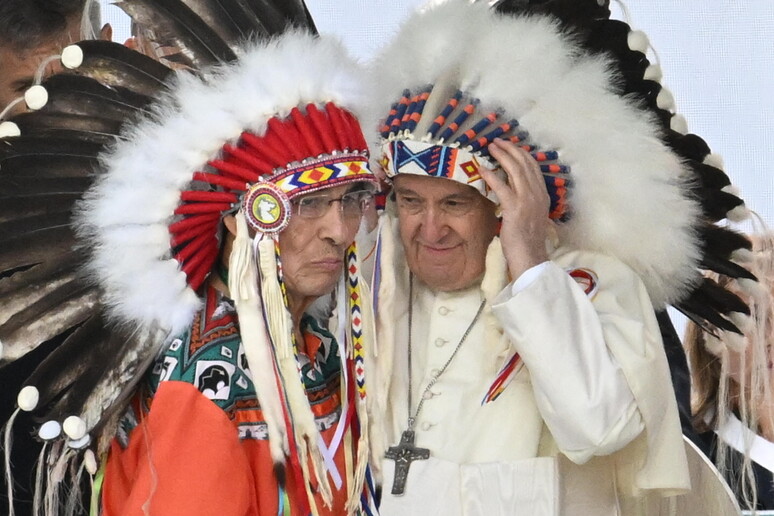
Recall that between 2021 and 2022, a global media storm hit the Catholic Church regarding the Native people of North America: the discovery of unmarked graves, the terrible Indian residential schools, and finally the apology by Pope Francis. Let us analyse, in brief, the issue.
The Indian residential schools
The ‘management’ of the conquest of North America and its peoples, compared to other European colonial ‘enterprises’, offers some extraordinary peculiarities: after the birth of the United States, independent of Europe, there was a kind of ‘calibrated, good-natured violence’, with which the young America tried to distinguish itself, in a positive way, from the Euro-imperialist policies of the old powers from which it had freed itself. Hence, in the nineteenth century, the Indian reservation system and the mechanism of assimilation and cultural genocide enacted through the residential schools were born out of unjust laws and discrimination. From the classic motto ‘The only good Indian is a dead Indian’, it changed to ‘Kill the Indian, save the man’.
Educating the ‘savages’ was esteemed as the only method not to exterminate them – or rather, to exterminate them in apparently less bloody ways. But let us go to the Indian residential schools: first in the United States, and then in Canada, forced education of native youth began. Native children were taken away from their families and their ‘pernicious’ traditions, being forced to become, as Francis La Flesche wrote, ‘white men for pretense’: cutting their hair, giving them a Christian name, studying the English language, adopting the Christian religion, and teaching and practising labour work for boys and domestic work for girls. The native students had to produce and finance the school facilities themselves, which were run on the cheap. In the Carlisle Indian Industrial School and other Indian boarding schools, they had to learn how to make harnesses for horses, produce tin goods and hand-build furniture and wagons.
The majority of state-run schools were soon handed over for convenience to missionaries and religious bodies, mostly Catholic, for a minimal – miserable – payment per native student. The scarcity of such figures led the poor children to malnutrition, disease and epidemics, and attracted low-paid school staff, most of them of very dubious morality: physical, sexual and moral abuse in these schools led to devastating mortality rates, as well as suicides of the young natives. A 2001 report by the Truth Commission into Genocide in Canada also mentions horrific experiments and practices. This system of Indian residential schools went on, in the United States and Canada, until the recent and unsuspected 1990s.
The discovery of the unmarked graves
As of late May 2021, surveys with Ground Penetration Radar reported the presence of hundreds, then thousands of possible remains of native students in the grounds of former Indian residential schools in Canada, mostly Catholic. Exclamations of dismay and indignation resounded in the world media and on social media. Despite the fact that these wretched remains, to this day, have still not been brought to light, – triggering some denialist opinions – the eyes of the world have been presented with the horrifying image of this abused, desecrated, raped native youth. Which, by the way, Native Americans and Canadians have always talked about, since the early 1900s.
It must be said: the greatest responsibility for what happened – regardless of how many bodies may ever be dug up – goes to the US and Canadian governments, who enacted the laws and forced the Native youth to attend these schools, and then gave them over to the Christian Churches. It was primarily the Catholic Church that was held responsible. Prime Minister Trudeau himself has called the Pope and the Church into question. Why? The reasons for this ‘jumping to conclusions’ on the findings of the former residential schools are complex: economic and political, sensationalist, and also conditioned by the well-known decline in the popularity of the Catholic Church in recent years. Recall, for example, the abuse scandals in Ireland that came to light in January 2021, and those in Scotland in 2018.
As historian Marc Bloch wrote: ‘A fake news story always arises from collective representations that pre-exist its birth; it is only apparently fortuitous or, more precisely, all that is fortuitous in it is the initial incident, absolutely insignificant, that triggers the work of the imagination; but this set in motion only takes place because the imaginations are already prepared and in silent ferment’.
In reality, the issue is also, and above all, an economic one: for several years now, in Canada and the United States, there have been numerous lawsuits with claims for compensation from residential school survivors and victims’ families; in fact, analysing the issue, as I did in a recent essay of mine (The Indian Residential Schools. The Unmarked Graves and Pope Francis’s Apology), the Canadian government has already had to disburse several million dollars and the Catholic Church and the CCCB, the Canadian Congress of Catholic Bishops, have instead sought to postpone or reduce the sums to be disbursed.
The destruction of churches and monuments in Canada
The Catholic Church’s involvement and Pope Francis’s call to action were exacerbated by the angry reaction of Native Canadians after the first grave surveys: as many as 85 churches have been damaged or burned since the end of May 2021. In addition to loud calls from Minister Trudeau and the Native communities, the CCCB also pressed the Pope for a public apology.
The apology mechanism
‘The offer of apology has become so commonplace in world politics that some have called this the age of apology,’ wrote Andrew Rigby, Professor Emeritus of Peace Studies, in 2001. States are not the only ones to offer apologies, but also businesses, non-governmental organisations, celebrities, and even religious figures. Sociologist Nicholas Tavuchis has pointed out the paradoxical nature of apologies: ‘Apologies, however sincere or effective, do not and cannot erase what has been done. Yet, in a mysterious way and according to their own logic, that is precisely what they manage to do’.
Andrew Woolford, also a sociologist, observes that, in this kind of reparation, it is often the case that ‘… a dominant group exerts assimilation pressures on a less powerful group’, thus removing even a semblance of justice from the reconciliation process.
Pope Francis’ apology
At the end of July 2022, after a couple of postponements and a visit to the Vatican by delegations of Native Canadians accompanied by CCCB bishops, the Pope finally sailed across the ocean to offer an apology to the Native communities. An apology that was much appreciated by some and deemed insufficient and partial by others. There is a lot of background and we cannot go into it all here, but a few things should be noted.
First of all, the intervention of Pope Francis gave incredible visibility to the whole affair: to the indigenous communities and in particular to their tragic past. At last, forced assimilation and genocide – cultural and otherwise – has been spoken of. The history of the Native Americans cannot, and must not, be hushed up: it is too important to understand past and ongoing political mechanisms, but also to do justice to a people who have suffered the pains of hell.
Then, many unresolved issues were also brought to light on the current legislation that relegates and discriminates against the indigenous peoples, who are still in the forefront of the fight to defend their rights.
Finally: the issue of unmarked graves. This remains an unresolved dilemma. The bodies have not yet been excavated at the various sites where the Ground Penetration Radar has reported their presence. But we ask: is it really necessary to dig and count the bodies?
This can only be decided by the indigenous communities, who must come to terms with their grief.
Published originally in Italian in The AntiDiplomatico, 11 March 2024
“Nativi” column by Raffaella Milandri
https://www.lantidiplomatico.it/news-nativi/53237/
Articles by Raffaella Milandri
- Revenge of the Native Americans? Killers of the Flower Moon and Lily Gladstone
- What lies behind Pope Francis’ apology to Native Americans, exploring the historical context and significance of his statement in relation to Indigenous rights and healing
- The truth about Indian reservations. The lands do not belong to the Native Americans
- Forgetting the Native American Genocide: over 55 million dead
- Forced sterilisation: the latest weapon against Native Americans
- Leonard Peltier: the appeal for the Native American activist after 47 years of maximum security imprisonment
- Sioux-Lakota ban Governor Kristi Noem from entering Indian reservations
- Indian reservations inspired Nazi concentration camps
- Nuclear tests and toxic waste on Indian reservations. The film ‘Oppenheimer’ doesn’t tell it right
- Secret medical experiments on Native people in Canada: a lawsuit to prove it still happens today
- The ‘Manifest Destiny’ of the United States, Native Americans and the Rest of the World
- How do Native Americans see the situation in Gaza: a parallel path?
- Native American voting discrimination in US elections
- The paradox of Puerto Rico: American citizens but without the right to vote
- Native Americans and firewater (and Tim Sheehy’s statements)
- Alarm over Canadian police violence towards Native people: nine dead in the last month alone
- Canada tried – and still insists – on erasing Native rights
- Biden apologises to Native Americans: the (negative) comments and the background
 Nativi Americani ieri e oggi
Lascia un commento